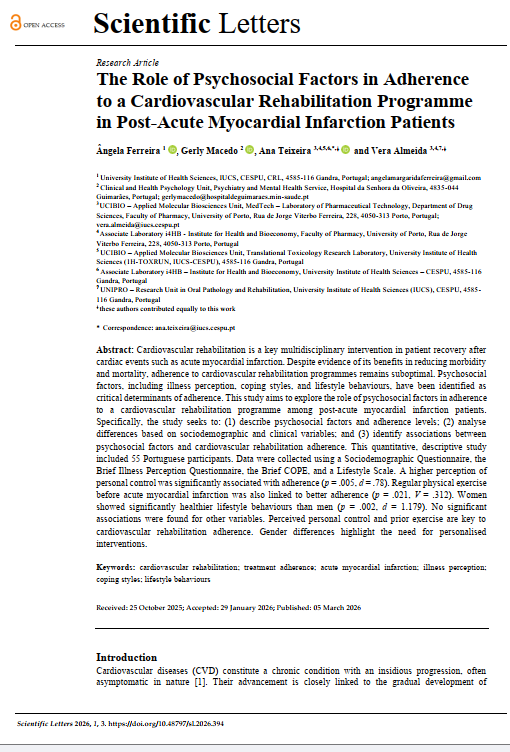
The Role of Psychosocial Factors in Adherence to a Cardiovascular Rehabilitation Program in Post-Acute Myocardial Infarction Patients
DOI:
https://doi.org/10.48797/sl.2026.394Keywords:
Cardiovascular rehabilitation, Treatment adherence, Acute myocardial infarction, Illness perception, Coping styles, Lifestyle behavioursAbstract
Cardiovascular rehabilitation is a key multidisciplinary intervention in patient recovery after cardiac events such as acute myocardial infarction. Despite evidence of its benefits in reducing morbidity and mortality, adherence to cardiovascular rehabilitation programmes remains suboptimal. Psychosocial factors, including illness perception, coping styles, and lifestyle behaviours, have been identified as critical determinants of adherence. This study aims to explore the role of psychosocial factors in adherence to a cardiovascular rehabilitation programme among post-acute myocardial infarction patients. Specifically, the study seeks to: (1) describe psychosocial factors and adherence levels; (2) analyse differences based on sociodemographic and clinical variables; and (3) identify associations between psychosocial factors and cardiovascular rehabilitation adherence. This quantitative, descriptive study included 55 Portuguese participants. Data were collected using a Sociodemographic Questionnaire, the Brief Illness Perception Questionnaire, the Brief COPE, and a Lifestyle Scale. A higher perception of personal control was significantly associated with adherence (p = .005, d = .78). Regular physical exercise before acute myocardial infarction was also linked to better adherence (p = .021, V = .312). Women showed significantly healthier lifestyle behaviours than men (p = .002, d = 1.179). No significant associations were found for other variables. Perceived personal control and prior exercise are key to cardiovascular rehabilitation adherence. Gender differences highlight the need for personalised interventions.References
Gil, V.M. Risco Cardiovascular; Lidel - Edições Técnicas, Lda, 2023; ISBN 9789897528811.
Candreva, A.; Buongiorno, A.L.; Matter, M.A.; Rizzini, M.L.; Giacobbe, F.; Ravetti, E.; Giannino, G.; Carmagnola, L.; Gilhofer, T.; Gallo, D.; et al. Impact of Endothelial Shear Stress on Coronary Atherosclerotic Plaque Progression and Composition: A Me-ta-Analysis and Systematic Review. Int. J. Cardiol. 2024, 407, 132061, doi:10.1016/j.ijcard.2024.132061.
Homem, F.; Caetano, A.; Reveles, A.; Martins, H.; Sousa, J.; Rodrigues, L.; Azevedo, T.; Loureiro, M.; Delgado, B. Manual de Apoio à Consulta de Enfermagem Ao Utente Com Patologia Cardiovascular; 2023; ISBN 978-989-33-2846-0.
Marques-Reis, J.P.; Morgado, P.; Rocha, J. Morbilidade e Mortalidade Por Doenças Cardiovasculares: Revisão Sistémica Dos Fatores de Risco. In Desigualdades em saúde, desigualdades no território: desafios para os países de língua portuguesa em contexto de pós pandemia; Marques da Costa, E., Louro, A., Eds.; Centro de Estudos Geográficos, Instituto de Geografia e Or-denamento do Território, Universidade de Lisboa, 2022; pp. 81–89 ISBN 9789726363026.
Archundia Herrera, M.C.; Subhan, F.B.; Chan, C.B. Dietary Patterns and Cardiovascular Disease Risk in People with Type 2 Dia-betes. Curr. Obes. Rep. 2017, 6, 405–413, doi:10.1007/s13679-017-0284-5.
Vieira, F.C.; Fonseca Machado, C.; Valcari, U.K.; Souza, A.; Filho, M. Prevalência Dos Fatores de Risco Em Paciente Com Infarto Agudo Do Miocárdio: Revisão Bibliográfica. Revista Científica do Tocantins 2022, 2, 1–14.
Martiniano, M.G. Estilos de Vida Dos Profissionais de Saúde Da Unidade Local de Saúde Do Nordeste. Master Thesis, Instituto Politécnico de Bragança: Bragança, 2017.
Ministério da Saúde; Direção-Geral da Saúde Programa Nacional Para a Promoção Da Alimentação Saudável 2022-2030; Direção-Geral da Saúde: Lisboa, 2022;
Balraj, S.H.; Jenny, M.H.C.; Shah, E.; Tiffany, M.; Neil, O.; Karen, R.; David, R.T.; Rod, S.T. Exercise‐based Cardiac Rehabilita-tion for Coronary Heart Disease. Cochrane Database of Systematic reviews 2011, 7, doi:10.1002/14651858.CD001800.pub2.
Thomson, P.; Rushworth, G.F.; Andreis, F.; Angus, N.J.; Mohan, A.R.; Leslie, S.J. Longitudinal Study of the Relationship be-tween Patients’ Medication Adherence and Quality of Life Outcomes and Illness Perceptions and Beliefs about Cardiac Rehabil-itation. BMC Cardiovasc. Disord. 2020, 20, doi:10.1186/s12872-020-01378-4.
Petrie, K.J.; Weinman, J. Patients’ Perceptions of Their Illness: The Dynamo of Volition in Health Care. Curr. Dir. Psychol. Sci. 2012, 21, 60–65, doi:10.1177/0963721411429456.
Kucukarslan, S.N. A Review of Published Studies of Patients’ Illness Perceptions and Medication Adherence: Lessons Learned and Future Directions. Research in Social and Administrative Pharmacy 2012, 8, 371–382, doi:10.1016/j.sapharm.2011.09.002.
Minjie, Z.; Zhijuan, X.; Xinxin, S.; Shan, Q. Mediating Effect of Coping Strategy and Psychological Status between Illness Per-ception and Quality of Life among Patients with Atrial Fibrillation: A Cross-Sectional Study. BMC Cardiovasc. Disord. 2024, 24, doi:10.1186/s12872-024-04176-4.
Lazarus, R.S.; Folkman, S. Stress: Appraisal and Coping; Springer: New York, 1984; ISBN 9780826141910.
Endler, N.S.; Parker, J.D.A. Multidimensional Assessment of Coping: A Critical Evaluation. J. Pers. Soc. Psychol. 1990, 58, 844–854, doi:10.1037/0022-3514.58.5.844.
Sadr Bafghi, S.M.; Ahmadi, N.; Yassini Ardekani, S.M.; Jafari, L.; Bitaraf Ardekani, B.; Heydari, R.; Maroufi, F.; Faraji, R. A Sur-vey of Coping Strategies With Stress in Patients With Acute Myocardial Infarction and Individuals Without a History of Fixed Myocardial Infarction. Cardiol. Res. 2018, 9, 35–39, doi:10.14740/cr655w.
Hammer, A.; Sinkovec, H.; Todorovic, M.; Katsch, F.; Gall, W.; Duftschmid, G.; Heinze, G.; Niessner, A.; Sulzgruber, P. Adher-ence to Secondary Prevention Measures after Acute Myocardial Infarction and Its Impact on Patient Outcome - A Nationwide Perspective. J. Clin. Med. 2024, 13, 4964, doi:10.3390/jcm13164964.
World Health Organization Adherence to Long-Term Therapies: Evidence for Action; World Health Organization, 2003.
Ho, P.M.; Bryson, C.L.; Rumsfeld, J.S. Medication Adherence: Its Importance in Cardiovascular Outcomes. Circulation 2009, 119, 3028–3035, doi:10.1161/CIRCULATIONAHA.108.768986.
Losi, S.; Berra, C.C.F.; Fornengo, R.; Pitocco, D.; Biricolti, G.; Federici, M.O. The Role of Patient Preferences in Adherence to Treatment in Chronic Disease: A Narrative Review. Drug Target Insights 2021, 15, 13–20, doi:10.33393/dti.2021.2342.
Abreu, A.; Mendes, M.; Dores, H.; Silveira, C.; Fontes, P.; Teixeira, M.; Santa Clara, H.; Morais, J. Mandatory Criteria for Cardiac Rehabilitation Programs: 2018 Guidelines from the Portuguese Society of Cardiology. Revista Portuguesa de Cardiologia 2018, 37, 363–373, doi:10.1016/j.repc.2018.02.006.
Cowie, A.; Buckley, J.; Doherty, P.; Furze, G.; Hayward, J.; Hinton, S.; Jones, J.; Speck, L.; Dalal, H.; Mills, J.; et al. Standards and Core Components for Cardiovascular Disease Prevention and Rehabilitation. Heart 2019, 105, 510–515, doi:10.1136/heartjnl-2018-314206.
Neves, M.S. da C.; de Oliveira, M.F. Reabilitação Cardíaca Precoce Em Pacientes Pós-Infarto Agudo Do Miocárdio. Revista da Faculdade de Ciências Médicas de Sorocaba 2017, 19, 105–110, doi:10.23925/1984-4840.2017v19i3a2.
Ambrosetti, M.; Abreu, A.; Corrà, U.; Davos, C.H.; Hansen, D.; Frederix, I.; Iliou, M.C.; Pedretti, R.F.E.; Schmid, J.P.; Vigorito, C.; et al. Secondary Prevention through Comprehensive Cardiovascular Rehabilitation: From Knowledge to Implementation. 2020 Update. A Position Paper from the Secondary Prevention and Rehabilitation Section of the European Association of Preventive Cardiology. Eur. J. Prev. Cardiol. 2021, 28, 460–495, doi:10.1177/2047487320913379.
Thompson, G.; Wilson, I.M.; Davison, G.W.; Crawford, J.; Hughes, C.M. “Why Would You Not Listen? It Is like Being given the Winning Lottery Numbers and Deciding Not to Take Them”: Semi-Structured Interviews with Post-Acute Myocardial Infarction Patients and Their Significant Others Exploring Factors That Influence Participation in Cardiac Rehabilitation and Long-Term Exercise Training. Disabil. Rehabil. 2022, 44, 4750–4760, doi:10.1080/09638288.2021.1919213.
Li, P.; Zhang, W.; Wu, B. Adherence to Cardiac Rehabilitation in Patients with Acute Myocardial Infarction After PCI: A Scoping Review. J. Multidiscip. Healthc. 2024, 17, 4165–4176, doi:10.2147/JMDH.S483512.
Calvo, E.; Formiga, F.; Andreu-Periz, L.; Ariza-Solé, A.; Gómez-Hospital, J.A.; Comín-Colet, J. Componentes de La Valoración Geriátrica y Adherencia Terapéutica En El Paciente Anciano Con Infarto Agudo de Miocardio. Rev. Esp. Geriatr. Gerontol. 2022, 57, 28–32, doi:10.1016/j.regg.2021.06.002.
Mendes, M. Os Idosos São Candidatos Prioritários Na Reabilitação Cardíaca. Revista Portuguesa de Cardiologia 2021, 40, 21–23, doi:10.1016/j.repc.2020.11.002.
Turk-Adawi, K.I.; Grace, S.L. Narrative Review Comparing the Benefits of and Participation in Cardiac Rehabilitation in High-, Middle- and Low-Income Countries. Heart Lung Circ. 2015, 24, 510–520, doi:10.1016/j.hlc.2014.11.013.
Yildirim, D.; Baykal, D. Evaluation of Treatment Adherence and Illness Perception in Cardiology Patients. Niger. J. Clin. Pract. 2020, 23, 1305–1311, doi:10.4103/njcp.njcp_666_19.
Parashar, S.; Spertus, J.A.; Tang, F.; Bishop, K.L.; Vaccarino, V.; Jackson, C.F.; Boyden, T.F.; Sperling, L. Predictors of Early and Late Enrollment in Cardiac Rehabilitation, among Those Referred, after Acute Myocardial Infarction. Circulation 2012, 126, 1587–1595, doi:10.1161/CIRCULATIONAHA.111.088799.
French, D.P.; Cooper, A.; Weinman, J. Illness Perceptions Predict Attendance at Cardiac Rehabilitation Following Acute Myo-cardial Infarction: A Systematic Review with Meta-Analysis. J. Psychosom. Res. 2006, 61, 757–767, doi:10.1016/j.jpsychores.2006.07.029.
Hibbard, J.; Gilburt, H. Supporting People to Manage Their Health: An Introduction to Patient Activation; 1st ed.; The King’s Fund: London, 2014; ISBN 978 1 909029 30 9.
de Carvalho, A.S.R. Adesão à Terapêutica Nos Doentes Com Hipertensão Arterial: Relação Com Fatores Organizativos Dos Sistemas de Saúde. Master’s thesis, Faculdade de Medicina da Universidade do Porto, Repositório Aberto da Universidade do Porto: Porto, 2019.
Anchah, L.; Hassali, M.A.; Lim, M.S.H.; Ibrahim, M.I.M.; Sim, K.H.; Ong, T.K. Health Related Quality of Life Assessment in Acute Coronary Syndrome Patients: The Effectiveness of Early Phase I Cardiac Rehabilitation. Health Qual. Life Outcomes 2017, 15, doi:10.1186/s12955-016-0583-7.
Shanmugasegaram, S.; Oh, P.; Reid, R.D.; McCumber, T.; Grace, S.L. Cardiac Rehabilitation Barriers by Rurality and Socioeco-nomic Status: A Cross-Sectional Study. Int. J. Equity Health 2013, 12, doi:10.1186/1475-9276-12-72.
Hanna, A.; Yael, E.M.; Hadassa, L.; Iris, E.; Eugenia, N.; Lior, G.; Carmit, S.; Liora, O. ``It’s up to Me with a Little Support’’ – Adherence after Myocardial Infarction: A Qualitative Study. Int. J. Nurs. Stud. 2020, 101, 103416, doi:10.1016/j.ijnurstu.2019.103416.
Mckee, G.; Biddle, M.; O’Donnell, S.; Mooney, M.; O’Brien, F.; Moser, D.K. Cardiac Rehabilitation after Myocardial Infarction: What Influences Patients’ Intentions to Attend? European Journal of Cardiovascular Nursing 2014, 13, 329–337, doi:10.1177/1474515113496686.
Nabutovsky, I.; Breitner, D.; Heller, A.; Scheinowitz, M.; Klempfner, Y.; Klempfner, R. The First National Program of Remote Cardiac Rehabilitation in Israel-Goal Achievements, Adherence, and Responsiveness in Older Adult Patients: Retrospective Analysis. JMIR Cardio 2022, 6, e36947, doi:10.2196/36947.
Firoozabadi, M.G.; Mirzaei, M.; Grace, S.L.; Vafaeinasab, M.; Dehghani-Tafti, M.; Sadeghi, A.; Asadi, Z.; Basirinezhad, M.H. Sex Differences in Cardiac Rehabilitation Barriers among Non-Enrollees in the Context of Lower Gender Equality: A Cross-Sectional Study. BMC Cardiovasc. Disord. 2023, 23, 329, doi:10.1186/s12872-023-03331-7.
Adsett, J.A.; Morris, N.R.; Mudge, A.M. Predictors of Exercise Training and Physical Activity Adherence in People Recently Hospitalized with Heart Failure: A BRIEF REPORT. J. Cardiopulm. Rehabil. Prev. 2019, 39, E12–E16, doi:10.1097/HCR.0000000000000407.
Swardfager, W.; Herrmann, N.; Marzolini, S.; Saleem, M.; Farber, S.B.; Kiss, A.; Oh, P.I.; Lanctôt, K.L. Major Depressive Disorder Predicts Completion, Adherence, and Outcomes in Cardiac Rehabilitation: A Prospective Cohort Study of 195 Patients With Coronary Artery Disease. J. Clin. Psychiatry 2011, 72, 1181–1188, doi:10.4088/JCP.09m05810blu.
Krishnamurthi, N.; Schopfer, D.W.; Shen, H.; Whooley, M.A. Association of Mental Health Conditions With Participation in Cardiac Rehabilitation. J. Am. Heart Assoc. 2019, 8, doi:10.1161/JAHA.118.011639.
Almeida, L.S.; Freire, T. Metodologia Da Investigação Em Psicologia e Educação; 5th ed.; Priquilíbrios, 2017; ISBN 978-972-97388-5-2.
Fortin, de M.-F. Fundamentos e Etapas No Processo de Investigação; Lusodidacta, 2009; ISBN 9789898075185.
Stevens, S.S. On the Theory of Scales of Measurement. Science (1979). 1946, 103, 677–680, doi:10.1126/science.103.2684.677.
Machado, V.; Botelho, J.; Ramos, C.; Proença, L.; Alves, R.; Cavacas, M.A.; Mendes, J.J. Psychometric Properties of the Brief Illness Perception Questionnaire (Brief-IPQ) in Periodontal Diseases. J. Clin. Periodontol. 2019, 46, 1183–1191, doi:10.1111/jcpe.13186.
Pereira, A.; Patrício, T. SPSS – Guia Prático de Utilização.; 8th ed.; Edições Sílabo, 2013; ISBN 978-972-618-736-3.
Pais Ribeiro, J.L.; Rodrigues, A.P. Questões Acerca Do Coping: A Propósito Do Estudo de Adaptação Do Brief COPE. Psicolo-gia, Saúde & Doenças 2004, 5, 3–15.
Correia, A.F.S. e S. Adesão Ao Regime Terapêutico Da Pessoa Com Insuficiência Cardíaca. Master’s thesis, Escola Superior de Saúde de Viseu, Repositório do Instituto Politécnico de Viseu: Viseu, 2017.
Laureano, R. Testes de Hipósteses Com o IBM SPSS Statistics: O Meu Manual de Consulta Rápida; 3rd ed.; Edições Sílabo, 2022; ISBN 978-989-561-052-5.
Martins, C. Manual de Análise de Dados Quantitativos Com Recurso Ao IBM SPSS: Saber Decidir, Fazer, Interpretar e Redi-gir; Psiquilíbrios Edições, 2011; ISBN 978-989-8333-08-7.
Kim, H.-Y. Statistical Notes for Clinical Researchers: Assessing Normal Distribution Using Skewness and Kurtosis. Restor. Dent. Endod. 2013, 38, 52–54, doi:10.5395/rde.2013.38.1.52.
Cohen, J. A Power Primer. Psychol. Bull. 1992, 112, 155–159, doi:10.1037/0033-2909.112.1.155.
Folkman, S.; Moskowitz, J.T. Coping: Pitfalls and Promise. Annu. Rev. Psychol. 2004, 55, 745–774, doi:10.1146/annurev.psych.55.090902.141456.
Shahid, R.; Shoker, M.; Chu, L.M.; Frehlick, R.; Ward, H.; Pahwa, P. Impact of Low Health Literacy on Patients’ Health Outcomes: A Multicenter Cohort Study. BMC Health Serv. Res. 2022, 22, 1148, doi:10.1186/s12913-022-08527-9.
García-Sánchez, E.; Santamaría-Peláez, M.; González-Bernal, J.J.; González-Santos, J.; Sedano García, M.A.; De Juana Velasco, I.; Sánchez Hernández, J.; García Pardo, H.; Fernández-Solana, J. Impact of Cardiac Rehabilitation on Anxiety, Depression, and Health-Related Quality of Life in Cardiovascular Patients. The Egyptian Heart Journal 2025, 77, 64, doi:10.1186/s43044-025-00658-8.
Pietrzykowski, Ł.; Kasprzak, M.; Michalski, P.; Kosobucka, A.; Fabiszak, T.; Kubica, A. The Influence of Patient Expectations on Adherence to Treatment Regimen after Myocardial Infarction. Patient Educ. Couns. 2022, 105, 426–431, doi:10.1016/j.pec.2021.05.030.
Douma, E.R.; Kop, W.J.; Kupper, N. Associations Between Psychological Factors and Adherence to Health Behaviors After Percutaneous Coronary Intervention: The Role of Cardiac Rehabilitation. Annals of Behavioral Medicine 2024, 58, 328–340, doi:10.1093/abm/kaae008.
Hagger, M.S.; Orbell, S. A Meta-Analytic Review of the Common-Sense Model of Illness Representations. Psychol. Health 2003, 18, 141–184, doi:10.1080/088704403100081321.
Bandura, A. Self-Efficacy: The Exercise of Control; W. H. Freeman and Company: New York, 1997; ISBN 0716726262.
Schwarzer, R.; Luszczynska, A.; Ziegelmann, J.P.; Scholz, U.; Lippke, S. Social-Cognitive Predictors of Physical Exercise Adher-ence: Three Longitudinal Studies in Rehabilitation. Health Psychology 2008, 27, S54–S63, doi:10.1037/0278-6133.27.1(Suppl.).S54.
Carver, C.S.; Scheier, M.F.; Weintraub, K.J. Assessing Coping Strategies: A Theoretically Based Approach. J. Pers. Soc. Psychol. 1989, 56, 267–283, doi:10.1037/0022-3514.56.2.267.
Clark, A.M.; King-Shier, K.M.; Thompson, D.R.; Spaling, M.A.; Duncan, A.S.; Stone, J.A.; Jaglal, S.B.; Angus, J.E. A Qualitative Systematic Review of Influences on Attendance at Cardiac Rehabilitation Programs after Referral. Am. Heart J. 2012, 164, 835-845.e2, doi:10.1016/j.ahj.2012.08.020.
Dinis, A.; Gouveia, J.P.; Duarte, C. Contributos Para a Validação Da Versão Portuguesa Do Questionário de Estilos de Coping. Psychologica 2011, 54, 35–62, doi:10.14195/1647-8606_54_2.
Hiller, J.; Schatz, K.; Drexler, H. Gender Influence on Health and Risk Behavior in Primary Prevention: A Systematic Review. J. Public Health (Bangkok). 2017, 25, 339–349, doi:10.1007/s10389-017-0798-z.
Fernandes, A.C.; McIntyre, T.; Coelho, R.; Prata, J.; Maciel, M.J. Impact of a Brief Psychological Intervention on Lifestyle, Risk Factors and Disease Knowledge during Phase I of Cardiac Rehabilitation after Acute Coronary Syndrome. Revista Portuguesa de Cardiologia 2019, 38, 361–368, doi:10.1016/j.repc.2018.09.009.
Downloads
Published
How to Cite
Issue
Section
License
Copyright (c) 2026 Ângela Ferreira, Gerly Macedo, Ana Teixeira, Vera Almeida

This work is licensed under a Creative Commons Attribution 4.0 International License.
In Scientific Letters, articles are published under a CC-BY license (Creative Commons Attribution 4.0 International License), the most open license available. The users can share (copy and redistribute the material in any medium or format) and adapt (remix, transform, and build upon the material for any purpose, even commercially), as long as they give appropriate credit, provide a link to the license, and indicate if changes were made (read the full text of the license terms and conditions of use).
The author is the owner of the copyright.