Smart delivery of polyphenols: Alginate microencapsulation meets advanced skin models
DOI:
https://doi.org/10.48797/sl.2026.403Keywords:
Selected Oral CommunicationAbstract
Background: Polyphenols are promising cosmetic active ingredients due to their antioxidant and skin-protective properties. However, their instability and poor solubility limit their cosmetical application and effectiveness [1,2]. Microencapsulation in biocompatible polymers, such as alginate, arises as an excellent option to overcome these limitations by enhancing stability and enabling prolonged release [3]. Objective: This study aimed to evaluate the stability, bioactivity, and permeation of catechin, epicatechin, chlorogenic acid (CGA), neochlorogenic acid (NCGA), and their mixture in pure and encapsulated forms, using advanced 3D in vitro and ex vivo skin models, according to the European Regulation n.º 1223/2009. Methods: Polyphenols were encapsulated in sodium alginate by spray-drying (115/70 °C) and assessed by scanning electron microscopy (SEM), Differential scanning calorimetry (DSC), and Fourier transform infrared spectroscopy (FTIR). Antioxidant and antiradical activities were evaluated by Ferric Reducing Antioxidant Power (FRAP) and radical scavenging assays. Cytocompatibility was evaluated in keratinocytes (HaCaT) and fibroblasts (HDF). A 3D co-culture skin model was constructed and permeation results compared with ex vivohuman explants coupled to Franz diffusion cells and a reconstructed human epidermis model (SkinEthicTM). Results:Encapsulation yielded stable microparticles (37-53%) with improved thermal stability. Antioxidant/antiradical activities significantly increased, particularly for catechin, epicatechin, and CGA, demonstrating synergistic effects in the mixture. Encapsulated polyphenols presented higher cell viabilities (> 60% in HaCaT and > 80% in HDF), in comparison with the pure forms. Permeation studies revealed reduced compound diffusion and sustained release, particularly for catechin and epicatechin. Ex vivo human skin explants revealed minimal permeation of flavan-3-ols, while CGA, NCGA and the mixture surpassed 50% permeation after 24 hours of exposure. Furthermore, enhanced viability was observed following polyphenol applications in the constructed 3D and SkinEthicTM models, while tissue integrity was preserved (Figure 1). Conclusions: Alginate microencapsulation enhanced the stability, bioactivity, and safety of polyphenols, while enabling controlled skin delivery. The combined use of advanced 3D and ex vivo models provides relevant insight into polyphenols’ permeation and supports their use as innovative cosmetic ingredients.
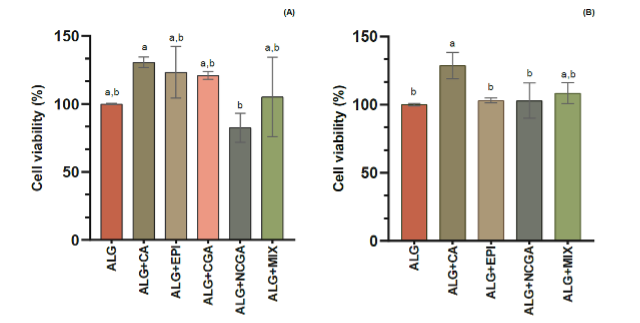
Figure 1. MTT assay with (A) 3D co-culture model and (B) SkinEthicTM RHE model after exposure to alginate microparticles. Results are expressed as mean ± standard deviation (SD) (n=3). Different letters (a,b) indicate significant differences between the compounds (p<0.05).
References
1. Costa Gagosian, V.S. et al. In vitro skin models as non-animal methods for dermal drug development and safety assessment. Pharmaceutics 2025, 17, 1342, doi:10.3390/pharmaceutics17101342.
2. Farhan, M. The promising role of polyphenols in skin disorders. Molecules 2024, 29, 865, doi:10.3390/molecules29040865.
3. Bińkowska, W. et al. Microencapsulation of Polyphenols and Their Application in Food Technology. Appl Sci 2024, 14(24), 11954, doi:10.3390/app142411954.
Downloads
Published
How to Cite
Issue
Section
License
Copyright (c) 2026 Mariana Marques, Filipa Teixeira, Berta Estevinho, Stefano Dall’Acqua, Francisca Rodrigues

This work is licensed under a Creative Commons Attribution 4.0 International License.
In Scientific Letters, articles are published under a CC-BY license (Creative Commons Attribution 4.0 International License), the most open license available. The users can share (copy and redistribute the material in any medium or format) and adapt (remix, transform, and build upon the material for any purpose, even commercially), as long as they give appropriate credit, provide a link to the license, and indicate if changes were made (read the full text of the license terms and conditions of use).
The author is the owner of the copyright.