Co-Exposure to Microplastics and Parabens: Implications for Chlorella vulgaris Bioremediation Efficiency
DOI:
https://doi.org/10.48797/sl.2026.415Keywords:
Selected Oral CommunicationAbstract
Background: Microplastics (MPs) are pervasive contaminants in aquatic systems and wastewater (WW), with polystyrene microplastics (PS-MPs) posing significant ecotoxicological risks [1]. MPs can also act as carriers for emerging contaminants [2], such as parabens—widely used preservatives frequently detected in WW [3]. Their co-occurrence raises concerns about combined effects on treatment efficiency and ecosystem health. Objective: This study evaluated the individual and combined effects of PS-MPs and methylparaben (MetP) on the physiological responses and bioremediation performance of Chlorella vulgaris in synthetic WW. Methods: C. vulgaris was exposed to 100 mg PS-MPs/L [4] and MetP (0.796 mg/L, [3]), individually and in co-exposure, under controlled growth conditions for 168 h. Microalgal growth, metabolic activity, nutrient removal, and contaminant fate were assessed. Adsorption assays were also performed to evaluate interactions between PS-MPs and MetP. Results: Short-term exposure (72 h) impaired metabolic activity and increased intracellular reactive oxygen species production. However, after 168 h, C. vulgarisrecovered metabolic function, indicating potential activation of adaptive defense mechanisms. PS-MPs caused moderate growth inhibition (14%), while MetP alone or combined with PS-MPs did not significantly affect microalgal growth. Despite physiological stress, nutrient removal remained high, with nitrogen removal up to 80% and phosphorus removal between 63–70%. Also, C. vulgaris removed 21.34 ± 1.12% of MetP, which increased to 26.20 ± 4.44% in the presence of PS-MPs, suggesting a vector effect. The adsorption assays showed that PS-MPs retained 0.61 ± 0.05 mg MetP per g, enhancing its bioavailability, while no significant PS-MPs degradation occurred over 168 h, by the microalga. Conclusions: Overall, C. vulgaris demonstrated resilience under combined contaminant exposure, maintaining WW treatment performance and partially removing organic micropollutants. The interaction between PS-MPs and MetP enhanced contaminant uptake, highlighting the role of MPs as vectors for ECs. These findings support the potential of microalgal systems as eco-efficient solutions for treating WW contaminated with MPs and co-occurring pollutants.
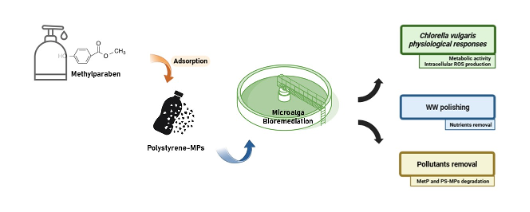
Figure 1. Physiological responses and bioremediation efficiency of C. vulgaris under individual and combined exposure to 100 mg PS-MPs/L and 0.796 mg MetP/L, under WW-mimicking conditions.
References
1. Kik, K. et al. Polystyrene nanoparticles: Sources, occurrence in the environment, distribution in tissues, accumulation and toxicity to various organisms. Environ Pollut 2020, 262, 114297, doi:10.1016/j.envpol.2020.114297
2. Martín, J. et al. Microplastics and associated emerging contaminants in the environment: Analysis, sorption mechanisms and effects of co-exposure. Trends Environ Anal Chem 2022, 35, e00170, doi:10.1016/j.teac.2022.e00170
3. Błędzka, D. et al. Parabens. From environmental studies to human health. Environ Int 2014, 67, 27–42, doi:10.1016/j.envint.2014.02.007
4. OECD. Test No. 201: Freshwater Alga and Cyanobacteria, Growth Inhibition Test. 2011.
Downloads
Published
How to Cite
Issue
Section
License
Copyright (c) 2026 Paulo Sousa, Cátia Sousa, Manuel Simões

This work is licensed under a Creative Commons Attribution 4.0 International License.
In Scientific Letters, articles are published under a CC-BY license (Creative Commons Attribution 4.0 International License), the most open license available. The users can share (copy and redistribute the material in any medium or format) and adapt (remix, transform, and build upon the material for any purpose, even commercially), as long as they give appropriate credit, provide a link to the license, and indicate if changes were made (read the full text of the license terms and conditions of use).
The author is the owner of the copyright.