Multidrug-resistant Enterococcus spp. in cattle farm environments: a One Health perspective
DOI:
https://doi.org/10.48797/sl.2026.417Keywords:
PosterAbstract
Background: Enterococcus spp. are commensals of humans and animals but also important opportunistic pathogens and reservoirs of antimicrobial resistance (AMR) [1]. Data on antibiotic-resistant enterococci in cattle remain limited in Europe, including Portugal [2,3], and the contribution of farm environments to AMR dissemination is largely unknown. Objective: To assess the occurrence and AMR profiles of Enterococcus spp. across cattle farm environments in Northern Portugal, including facilities, surrounding areas, and humans and animals in close contact. Methods: Thirtysamples were collected from three cattle farms in two cities, including fomites [feed trough, feed floor (n=2), medication room (n=2) and fridge surfaces, shoe soles (n=2; veterinarian and farmer), milking robot teat cups (n=3) and surfaces, milk storage and milking parlour surfaces, toilet surfaces (n=3)], environmental matrices [bedding sawdust, dog feces (n=2), pigeon feces, soil near the stable], feed (n=4), and milk [individual cow, robot-collected (n=2), and bulk tank milk]. Samples were pre-enriched in BHI with or without antibiotics (ampicillin/vancomycin/florfenicol) and plated on Slanetz-Bartley agar with or without antibiotics. Identification was performed by MALDI-TOF MS and susceptibility testing (EUCAST/CLSI). Prevalence was calculated per sample. Results: Enterococcus spp. were detected in 20/30 samples (67%) across all sample types except milking parlour surfaces. Resistance was most frequent to tetracycline (TET, 75%), erythromycin (ERY, 67%), and high-level streptomycin (STR, 42%), followed by ciprofloxacin (CIP) and chloramphenicol (CLO, 25% each), high-level gentamicin (CN, 17%), ampicillin (AMP) or linezolid (LIN, 8% each). Resistance to vancomycin was not observed. Multidrug-resistant enterococci (MDR; ≥3 classes) were identified in 25% of positive samples, namely from dog feces, feed (n=2) and shoe soles (n=2), particularly after antibiotic enrichment. MDR isolates included E. faecium (AMP+CIP+ERY+TET+STR) from dog feces and E. faecalis (LIN+CIP+ERY+TET+STR+CN+CLO) from a farmer’s shoe sole. Conclusions: Cattle farm environments are reservoirs of MDR Enterococcus spp., including strains resistant to critically important antibiotics such as linezolid. Although the sources of resistance, whether originating from cattle or other environmental sources, are unknown, results highlight potential environmental exposure and underscore the need for strengthened One Health AMR surveillance (Figure 1).
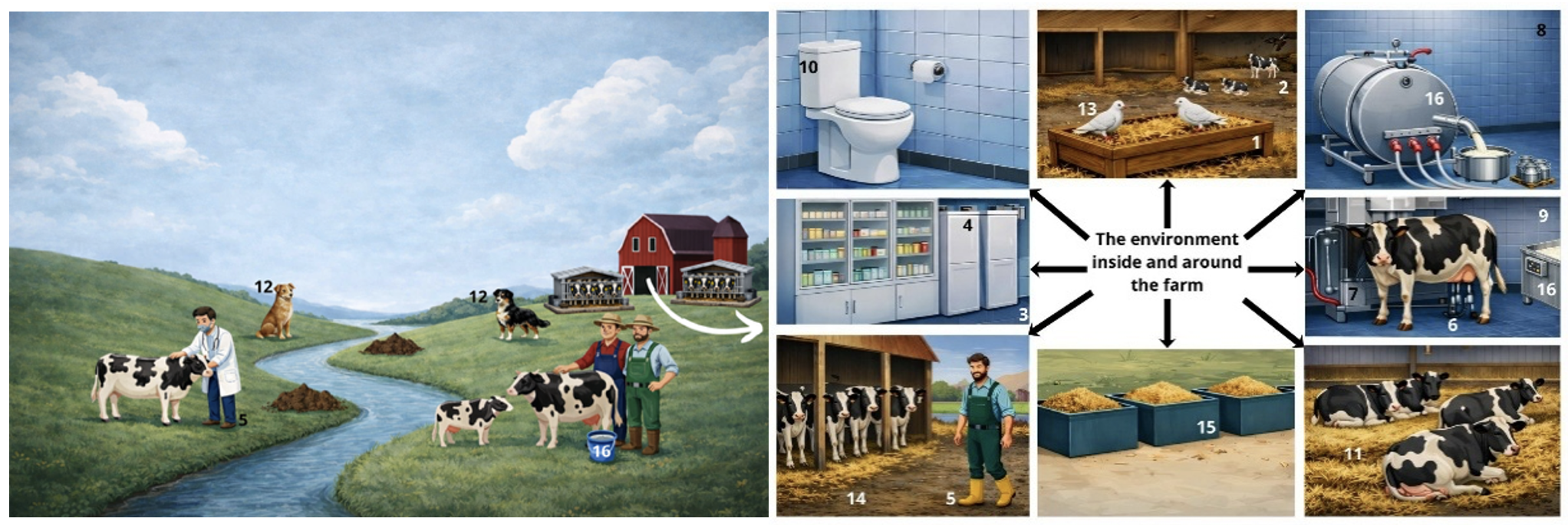
Figure 1. Schematic representation of the sampling sites within and around a cattle farm, encompassing animal-, human-, and environment-associated samples. Sites are numbered as follows: Fomites: 1, feed trough; 2, feed floor; 3, medication room surface; 4, medication fridge surface; 5, shoe soles (veterinarian and farmer); 6, milking robot teat cups; 7, milking robot surface; 8, milk storage room surface; 9, milking parlour surface; 10, toilet surfaces; Environmental matrices: 11, bedding sawdust; 12, dog feces; 13, pigeon feces; 14, soil near the stable; Feed - 15; Milk: 16, including individual cow, robot-collected, and bulk tank milk.
References
1. Zaidi, S.-E. et al. Enterococci as a One Health Indicator of Antimicrobial Resistance. Can J Microbiol 2024, 70, 303–335, doi:10.1139/cjm-2024-0024.
2. European Food Safety Authority; European Centre for Disease Prevention and Control. The European Union Summary Report on Antimicrobial Resistance in Zoonotic and Indicator Bacteria from Humans, Animals and Food in 2022–2023. EFSA J 2025, 23, e09237, doi:10.2903/j.efsa.2025.9237.
3. Gião, J. et al. Antimicrobial Susceptibility of Enterococcus Isolates from Cattle and Pigs in Portugal: Linezolid Resistance Genes optrA and poxtA. Antibiotics 2022, 11, 615, doi:10.3390/antibiotics11050615.
Downloads
Published
How to Cite
Issue
Section
License
Copyright (c) 2026 Catarina Madureira, Inês M. Ribeiro, Beatriz Neto, Luís Pinho, Carla Campos, Sandra Quinteira, Luísa Peixe, Ana C. Almeida-Santos, Carla Novais, Carla Miranda, Ana R. Freitas

This work is licensed under a Creative Commons Attribution 4.0 International License.
In Scientific Letters, articles are published under a CC-BY license (Creative Commons Attribution 4.0 International License), the most open license available. The users can share (copy and redistribute the material in any medium or format) and adapt (remix, transform, and build upon the material for any purpose, even commercially), as long as they give appropriate credit, provide a link to the license, and indicate if changes were made (read the full text of the license terms and conditions of use).
The author is the owner of the copyright.