Influence of microplastic exposure on nutrient uptake and growth performance of Chlorella vulgaris
DOI:
https://doi.org/10.48797/sl.2026.503Keywords:
PosterAbstract
Background: Microplastics (MPs) are persistent emerging contaminants frequently detected in wastewater (WW), where conventional treatment systems often fail to remove them, posing environmental and Human health risks [1]. Microalgae-based systems have emerged as sustainable alternatives for WW remediation due to their capacity for contaminants and nutrient removal [2]. However, the effects of MPs on microalgal performance and treatment efficiency under different WW operational conditions remain poorly understood. Objective: This study evaluated the physiological responses and bioremediation performance of Chlorella vulgaris exposed to different types of MPs under varying WW conditions. Methods: C. vulgaris was exposed to 100 mg/L [3] of five commonly detected MPs: polypropylene (PP), polystyrene (PS), polyamide (PA), low-density polyethylene (LDPE), and high-density polyethylene (HDPE). Experiments were conducted under different WW conditions: variations in nitrogen (N) availability, organic carbon concentration, and photoperiod regimes (12:12 h light/dark cycle versus continuous light). Microalgal growth, metabolic activity, and bioremediation efficiency were assessed. Results: MPs induced heterogeneous metabolic responses depending on the MPs’ type and environmental conditions. HDPE and LDPE consistently reduced esterase activity, whereas PS increased esterase activity under N-limited conditions. LDPE also induced intracellular oxidative stress specifically under N limitation. Despite these effects, C. vulgaris maintained growth and biomass production in most scenarios. Growth inhibition (13-27%) occurred only under combined nutrient starvation and a 12:12 h photoperiod. Heterotrophic metabolism partially compensated for reduced photosynthetic activity during dark phases. Under N-limited conditions, C. vulgaris achieved high bioremediation efficiency, removing up to 94 % of N and >97.5 % of glucose even in the presence of MPs. In contrast, limited organic carbon impaired nutrient removal due to energy constraints. Conclusions: Overall, WW conditions strongly modulated the physiological stress induced by MPs. Nutrient limitation and light/dark cycles intensified metabolic disturbances, whereas N-limited environments promoted adaptive responses that supported microalgal resilience. C. vulgaris maintained high bioremediation capacity in most conditions, highlighting its potential as a robust and eco-friendly tool for polishing MP-contaminated wastewater.
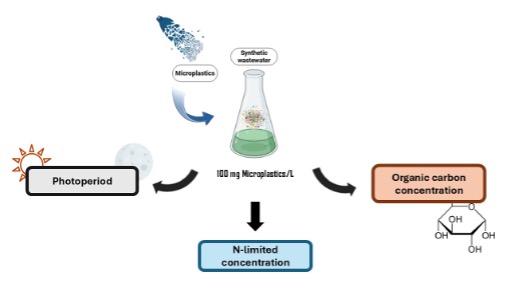
Figure 1. Wastewater bioremediation performance by exposing Chlorella vulgaris to different types of MPs, at 100 mg/L, under varying wastewater operational conditions.
References
1. Reddy, A.S. and Nair, A.T., The fate of microplastics in wastewater treatment plants: An overview of source and remediation technologies. Environ Technol Innov 2022, 28, 102815, doi:10.1016/j.eti.2022.102815.
2. Abdelfattah, A. et al. Microalgae-based wastewater treatment: Mechanisms, challenges, recent advances, and future prospects. Environ. Sci. Ecotechnology 2023, 13, 100205, doi:10.1016/j.ese.2022.100205.
3. Test No. 201: Freshwater Alga and Cyanobacteria, Growth Inhibition Test. OECD 2021.
Downloads
Published
How to Cite
Issue
Section
License
Copyright (c) 2026 Paulo Sousa, Cátia Sousa, Manuel Simões

This work is licensed under a Creative Commons Attribution 4.0 International License.
In Scientific Letters, articles are published under a CC-BY license (Creative Commons Attribution 4.0 International License), the most open license available. The users can share (copy and redistribute the material in any medium or format) and adapt (remix, transform, and build upon the material for any purpose, even commercially), as long as they give appropriate credit, provide a link to the license, and indicate if changes were made (read the full text of the license terms and conditions of use).
The author is the owner of the copyright.