Optimized Liposomal Delivery of Actinidia arguta Antioxidants for Topical Skin Applications
DOI:
https://doi.org/10.48797/sl.2026.402Keywords:
Selected Oral CommunicationAbstract
Background: Natural bioactive compounds offer therapeutic and cosmetic benefits but are often limited by low stability and poor skin penetration. Liposomal nanocarriers represent a promising strategy to overcome these barriers [1]. Objective: Optimize liposomes encapsulating an extract from Actinidia arguta fruit for topical use, with potential relevance in antitumor skin therapies. Methods: The extract was obtained by ultrasound-assisted extraction [2] and incorporated into phospholipid liposomes via probe sonication [3]. A central composite design was applied to optimize lecithin, extract concentration, and sonication amplitude, targeting minimal vesicle size (VS) and polydispersity index (PDI), and maximal encapsulation efficiency (EE). The optimized liposomes were characterized regarding phytochemical composition (LC-DAD-MS), structural integrity (TEM, FTIR, DSC) and stability. Biocompatibility was investigated by measuring cell viability of HDFa, HaCaT, and A375 cells after 24 h of exposure using the MTT assay. Results: The optimized liposomes consisted of 167.9 mg/mL lecithin, 42.5 mg/mL extract, and 28% amplitude (R² = 0.995), yielding nanosized vesicles (107.2±2.2 nm) with uniform distribution (PDI of 0.173±0.011), a strongly negative zeta potential (ZP; −47.8±1.6 mV), and an EE of 50.7±2.5%. LC-DAD-MS confirmed the presence of chlorogenic and neochlorogenic acids, catechin, kaempferol, quercetin, and sugar derivatives. Over 90 days, liposomes remained stable (VS<150 nm; PDI<0.2; ZP −50 mV). TEM, FTIR and DSC (Figure 1A,B,C) indicated preserved lipid structure and extract integrity, with evident interactions between the bioactives and phospholipids. Biocompatibility studies (Figure 1D) showed >70% viability in keratinocytes and fibroblasts, with mild stimulation at low doses. A375 melanoma cells exhibited slight, dose-dependent reductions in viability only at high concentrations, suggesting nonspecific metabolic effects related to the lipid vesicles or the sugars present on the extract. Conclusions: The optimized liposomal system efficiently encapsulates A. arguta fruit antioxidants, while maintaining stability and safety, supporting its suitability for topical delivery and further evaluation in melanoma models.
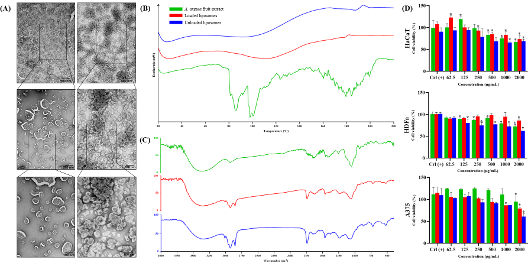 Figure 1. Characterization of optimized liposomes: (A) TEM images of loaded (left) and unloaded liposomes (right), (B) DSC thermograms, (C) FTIR spectra and (D) HaCaT, HDFa and A375 cell viability after 24h of exposure (n = 3); *p < 0.05.
References
1. Yang, S. et al. Encapsulating plant ingredients for dermocosmetic application: an updated review of delivery systems and characterization techniques. Int J Cosmet Sci 2020, 42, 16-28, doi:10.1111/ics.12592
2. Macedo, C. et al. Insights into the polyphenols extraction from Actinidia arguta fruit (kiwiberry): A source of pro-healthy compounds. Sci Hortic 2023, 313, 111910, doi:10.1016/j.scienta.2023.111910
3. Villegas-Aguilar, MdC. et al. Targeted breast cancer therapy using novel nanovesicle formulations of Olea europaea extract. Biomed Pharmacother 2024, 180, 117583, doi:10.1016/j.biopha.2024.117583
Downloads
Published
How to Cite
Issue
Section
License
Copyright (c) 2026 Filipa Teixeira, Marta Oliveira, Maria de la Luz Cádiz-Guerra, Francisco Javier Leyva-Jiménez, Francisca Rodrigues

This work is licensed under a Creative Commons Attribution 4.0 International License.
In Scientific Letters, articles are published under a CC-BY license (Creative Commons Attribution 4.0 International License), the most open license available. The users can share (copy and redistribute the material in any medium or format) and adapt (remix, transform, and build upon the material for any purpose, even commercially), as long as they give appropriate credit, provide a link to the license, and indicate if changes were made (read the full text of the license terms and conditions of use).
The author is the owner of the copyright.